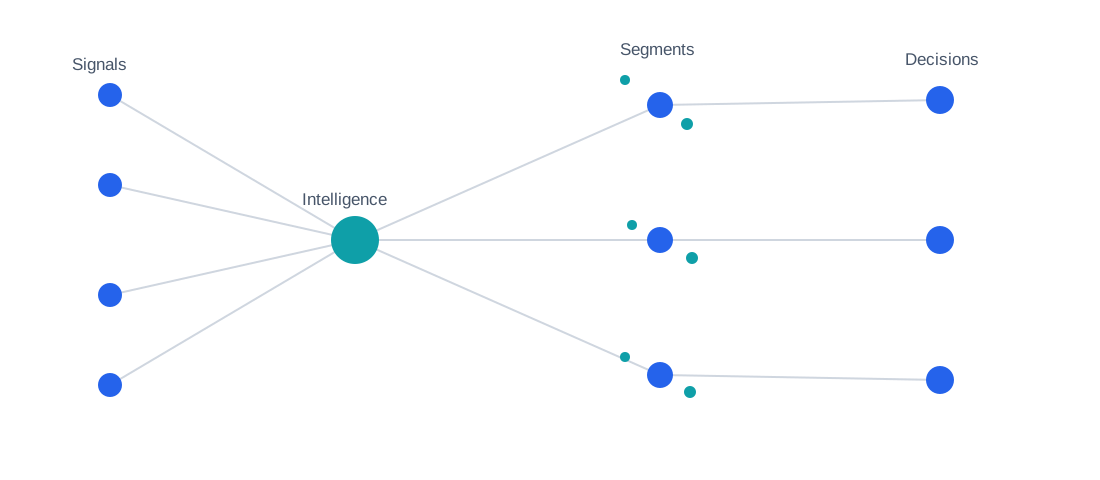
Clustering is a description of similarity. To become a business tool, every segment must connect to a specific decision, a decision owner and a measure of success.
Why this problem is harder than it looks
Most teams already have enough data to create segments. What is usually missing is a disciplined bridge between model output and a measurable action. Memorable cluster names do not substitute for that bridge.
A practical example
Consider a mid-market retailer operating across five behavioral segments. The trend below is used to check whether a retention change is actually moving the underlying business measure.
Higher response rate for messages aligned to lifecycle stage
Illustrative example showing the metric format; not a client result.Illustrative exampleWhat tends to break first
The common failure is delivering a score or label instead of an operational threshold. The team must know what behavioral change moves a customer into or out of a segment.
| Segment | Entry signal | Decision |
|---|---|---|
| High value | Lifetime value and repeat purchase | Protect service benefits |
| At risk | Three-week engagement decline | Retention intervention |
| New | First purchase within 30 days | Education and activation |
A segment nobody acts on is just a chart.
What to measure
Track the operational measure the analysis should influence alongside model quality. Cluster stability and actual retention impact can move in different directions.
const action = segment === "at-risk"
  && engagementDelta < -0.2
  ? "retention-review"
  : "observe";
Final considerations
This approach does not require an exotic model. It requires a disciplined path from data to a specific decision, plus periodic review of the thresholds as behavior changes.